Why I'm building a personal hub, not just a blog
A note on turning a quiet publishing site into a clearer record of projects, decisions, and the way I work.
Personal product · Maintained
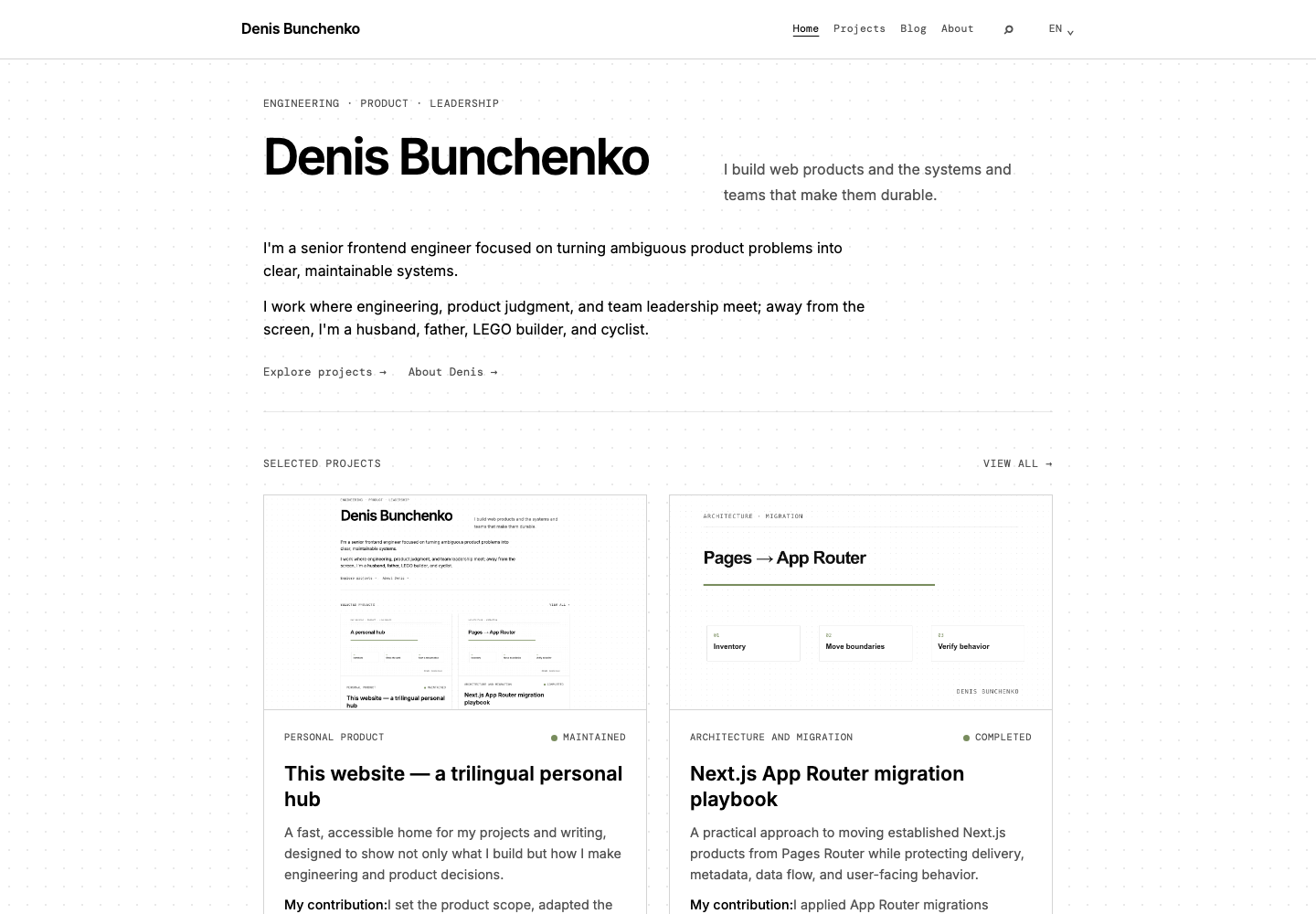
A fast, accessible home for my projects and writing, designed to show not only what I build but how I make engineering and product decisions.
Problem
A conventional blog feed did not explain the breadth of my work. A new visitor needed a quick route from who I am, through credible evidence, to a way to start a conversation.
Constraints
My role
I set the product scope, adapted the visual system, built the Astro implementation, created the multilingual content workflow, and added automated quality checks.
Key decisions
Articles and projects live in validated Astro content collections. A case study has a stable schema for status, role, decisions, results, media, and related writing rather than relying on page-specific markup.
Astro renders the core experience ahead of time. JavaScript is reserved for focused interactions such as search and the language menu, reducing runtime cost and failure modes.
Shared templates generate three locale trees, while translated content files keep substantial prose readable and independent. Canonical, hreflang, RSS, sitemap, and structured-data output are checked at build time.
A monochrome notebook-inspired system, restrained olive accent, strong typography, and visible grid replace decorative UI with hierarchy and generous reading space.
Results
Lessons
Screenshots
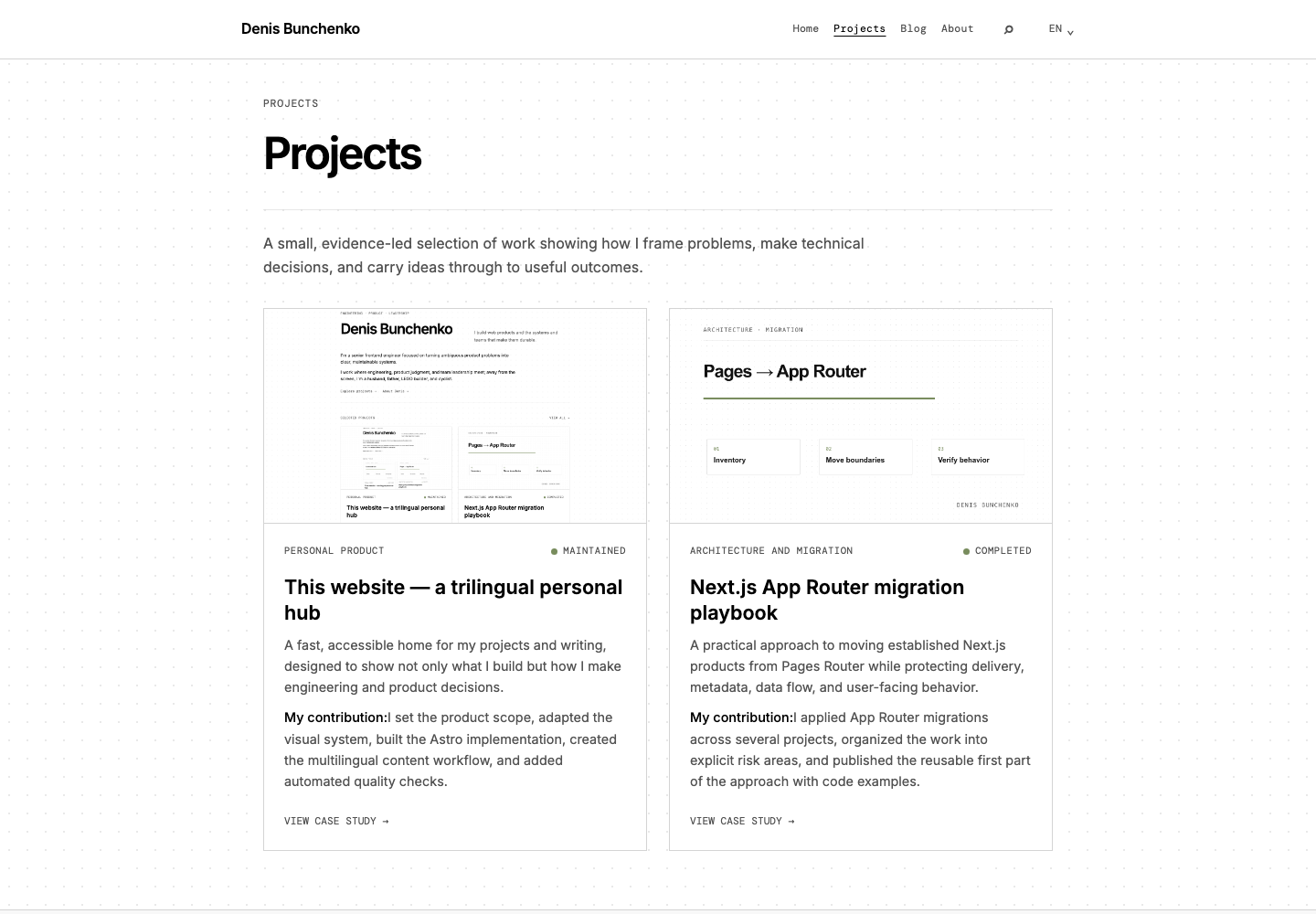
Completed now: the personal-hub information architecture, two full case studies, multilingual routes, project-aware search, a real launch article, contact form, newsletter, and the existing publishing and SEO pipeline.
Planned next: add case studies only when they can include public evidence, refresh results as the site is used, and keep reducing any interface element that does not help a visitor understand the work.
Long-form content stays in Markdown and is validated during the build. Every change passes formatting, linting, type, Astro, production-build, and generated-output checks before deployment to Netlify. That makes publishing closer to a small software release than to editing a database-backed CMS.
The file-based workflow is transparent, versioned, and portable, but it expects comfort with Git and Markdown. Maintaining three languages also adds deliberate editorial work. I accepted both costs because control, durable URLs, and inspectable output matter more here than browser-based editing or instant publishing.